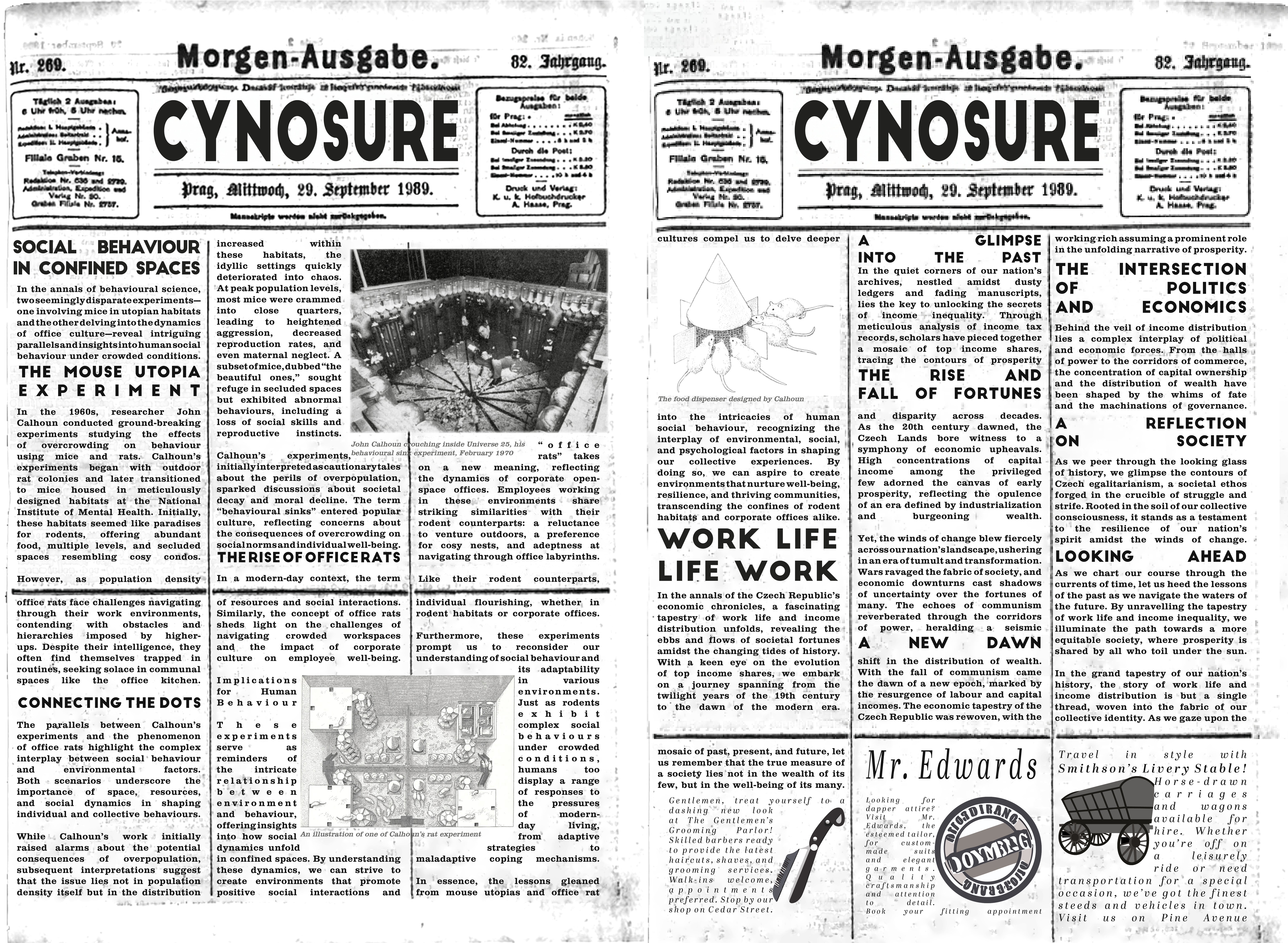
You traverse the concrete streets, your acceptance of Musil’s offer clutched in your hand. Others scurry past you, scattering dust in their wake. Employees call the corporate open-space office their home, often referred to as "office rats" for reasons beyond mere linguistic eccentricity. The parallels between the human workers and the rodents become apparent as you observe the peculiar behaviours that characterise both. The office rats, much like their rodent counterparts, seem reluctant to venture beyond the confines of their metropolis, navigating the labyrinthine Blanka tunnel complex like seasoned explorers. Their nests, warm and cosy, are perched on the highest floors, far from the grimy depths below. Witnessing them crawl through the tubes of the metro and elevators, you realise the extent of their agility and knack for navigating the intricate network of the city. The office rats exhibit a certain intelligence, yet their wanderings within the office labyrinth suggest a struggle to find purpose within their confined world. The office nests, filled with a mix of papers and mysterious substances, hint at the complexities of their existence. Obstacles imposed by unseen forces above them form an elaborate prison of nobody’s making. Experimentation and manipulation are part of the daily grind.
It becomes evident that, much like their rodent counterparts, these office rats endure suffering in their labyrinthine workplace. The allure of assembling in packs, driven by a common motivation for food and a breeding instinct expressed during Christmas parties, keeps them tethered to their corporate colonies. Amidst the kitchen gatherings, where the rats congregate around a refrigerator stocked with perfectly packaged soylent greens, you sense an unspoken camaraderie among them. Packs ranging from 20 to 60 individuals coexist in a confined space, navigating their shared territory without resorting to biting each other. A realisation strikes – the office rats are creatures with a purpose, intelligent and quick to learn, yet undeniably trapped within the constraints of their own labyrinth. You, too, feel the weight of responsibilities, much like a creature turning a machine, aware that tomorrow will dawn with the obligation to be alert, adaptable, and sociable. If there is such a thing as the soul, then surely they must know. “Od přírody jsme pohyblivými tvory a ne kancelářskými krysami.” "By nature, we are mobile creatures and not office rats."
In this world, rules are followed without question, for they are the fabric that prevents the cannibalization of the colony. An innate sense of spite for an irreparably futile existence fuels your dreams of overcoming these senseless structures, but if the foundations were to crumble, would your brethren eat each other alive?